
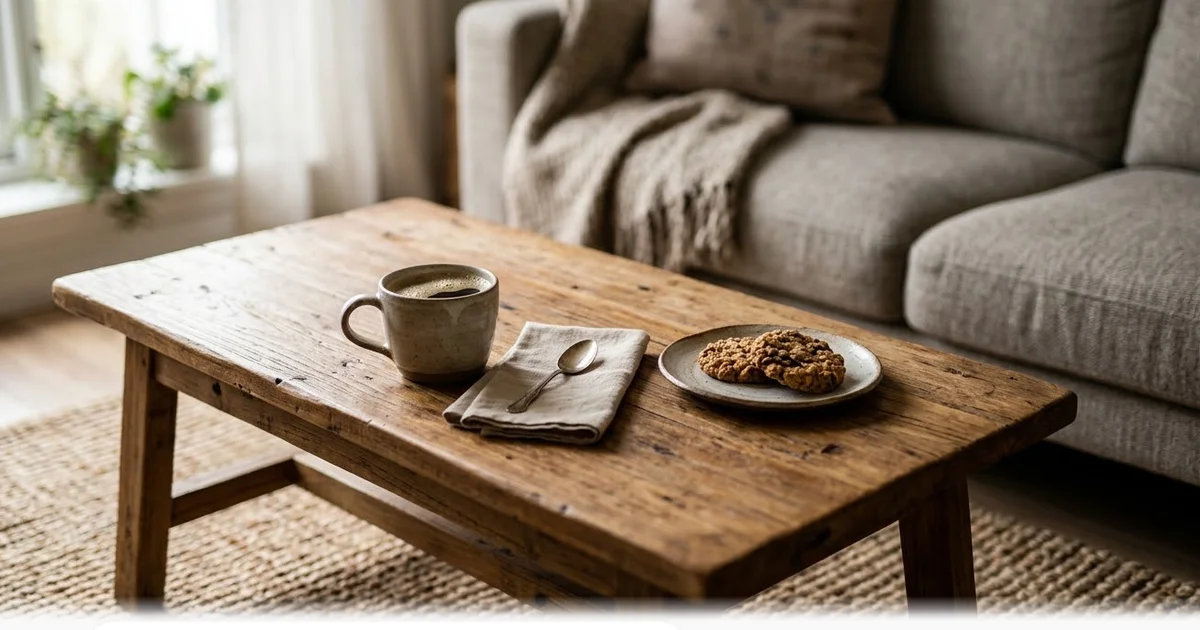
Choosing a Coffee Table: Dimensions, Height, Materials
Height, dimensions, material: how to choose a coffee table suited to your sofa and living room. The complete guide by Sunaya Home.
The coffee table occupies a central place in the organization of a living room: it holds coffee cups, evening books, the lost remote control, and sometimes even tired feet after a long day. Yet, this seemingly simple piece of furniture raises real technical questions when it comes to choosing one: what size to adopt in relation to the sofa, what height to prioritize, which material will last over time? At Sunaya Home, we assist customers daily who hesitate between several models without always knowing which criteria to rely on. This article gathers the essential guidelines for choosing a coffee table truly suited to your living room.
Why the Coffee Table Deserves Careful Consideration
Contrary to a common misconception, the coffee table is not a mere accessory chosen after the fact, once the sofa is installed. It directly influences circulation in the room, the visual balance of the space, and daily comfort of use. A table that is too large overwhelms the space, a table that is too low forces unnecessary bending, and a table poorly proportioned to the sofa disrupts the harmony of the room.
- It structures the living space and serves as a visual reference point between the sofa and the rest of the living room.
- It determines comfort of use: accessibility, seating height, reach distance.
- It contributes to the living room's decor identity, particularly in a Scandinavian style where natural materials dominate.
- It can offer additional storage, useful in small living rooms.
Before settling on an aesthetic favorite, it is therefore useful to review the dimensional criteria, then the questions of height and material, in this precise order.
What Coffee Table Dimensions Based on Your Living Room Size
The dimensions of a coffee table should always be considered in relation to the available space around the sofa, not just the size of the room. A widely shared rule of thumb among interior design professionals is to maintain a circulation space of at least 30 to 45 cm between the table and the sofa, as well as between the table and other furniture. Here is a reference table to guide your choice based on your living room configuration.
| Living Room Size | Recommended Length | Width or Diameter | Associated Sofa Type |
|---|---|---|---|
| Less than 15 m² | 70 to 90 cm | 40 to 50 cm | 2-seater sofa or compact straight sofa |
| 15 to 25 m² | 100 to 120 cm | 50 to 60 cm | 3-seater sofa |
| 25 to 35 m² | 120 to 140 cm | 60 to 70 cm | Corner or modular sofa |
| More than 35 m² | 140 cm and above, or a pair of tables | 70 cm and above | Large living room, multiple seating areas |
For small living rooms, it is often preferable to choose a round or oval table rather than a rectangular one with sharp corners: it facilitates circulation and visually lightens the space. If you are still unsure about the overall format of your seating before even thinking about the coffee table, our complete guide to choosing your sofa will help you lay the right foundations for your living room.
What Coffee Table Height to Choose Based on Your Sofa
Height is arguably the most often overlooked criterion, yet it directly determines comfort of use. A coffee table that is too high in relation to the sofa's seating forces you to raise your arm to reach an object on it; too low, it becomes difficult to access once seated, especially for elderly people or tall individuals.
- Proximity rule: the height of the coffee table should be roughly at the level of the sofa's seating, or slightly below, generally between 30 and 45 cm.
- Low and deep sofas, Scandinavian style: opt for a similarly low coffee table, around 30 to 35 cm, to respect the overall proportions of the furniture.
- High sofas, firm seating: a slightly higher coffee table, up to 45 cm, remains comfortable and avoids a visual crushing effect.
- Occasional dining or remote work use: some adjustable models allow you to modify the height as needed, an interesting option in multifunctional living rooms.
If your sofa has not yet been chosen, it is wiser to first define its seating height before selecting the coffee table: both pieces of furniture should be considered together. Our selection of seats and sofas allows you to compare available seating heights and anticipate the match with your future coffee table.
Which Material to Choose: Wood, Glass, Metal, or Rattan
The material of the coffee table influences both its aesthetics, durability over time, and daily maintenance. Each material has its advantages and constraints, which should be known before purchase.
- Solid wood: warm and durable, it fits naturally into a Scandinavian interior or one dominated by natural materials. It requires regular maintenance to preserve its appearance, especially with direct exposure to sunlight.
- Tempered glass: visually light, it enlarges the space in small living rooms but requires frequent cleaning to avoid fingerprints.
- Metal: robust and often associated with an industrial or contemporary style, it pairs well with a wood or glass top for a mixed look.
- Rattan and natural fibers: very present in bohemian or Scandinavian interiors, they add texture but remain more sensitive to humidity.
The choice of material should also consider the rest of your furniture. If your living room already includes open storage, it is useful to harmonize the tones and wood types with your range of shelves, to achieve overall visual coherence rather than a mix of disparate styles.
At Sunaya Home, we regularly observe that customers focus on the aesthetics of the coffee table while forgetting to check the actual height of their sofa. Our advice: always measure the seating height of your sofa before finalizing a coffee table, rather than relying solely on the product photo. A difference of a few centimeters is enough to make a living room uncomfortable on a daily basis.
Shapes, Scandinavian Style, and Modular Configurations
Beyond dimensions and material, the shape of the coffee table fully contributes to the overall ambiance of the living room. Clean lines and organic shapes currently dominate Scandinavian interiors, while modular configurations appeal to households that like to reorganize their space depending on the occasion.
Here are the main configurations found in contemporary living rooms:
- Single central coffee table: the classic solution, suitable for most medium-sized living rooms.
- Pair of nesting tables: ideal for small spaces, they fit together and separate as needed for entertaining.
- Coffee table with lift-top: practical for occasional dining in front of the TV or remote work.
- Associated side table: several small tables distributed around the sofa rather than a single central piece, highly popular in corner configurations.
These shape choices should remain consistent with the room's lighting ambiance: a glass coffee table will reflect more natural light, while a dark wood top will absorb light and require more generous supplementary lighting. To delve deeper into this topic, our complete guide to decorative lighting can help you create a balanced living room, coffee table included.
What About the Terrace? Considering the Outdoor Coffee Table
The same reasoning applied indoors also applies to garden living rooms: height adapted to the chairs, weather-resistant material, dimensions proportionate to the available space. On a terrace, a coffee table must also withstand humidity and temperature variations, which naturally leads to materials like treated wood, metal, or composite materials.
Some households opt for versatile solutions rather than a classic coffee table: a 90-liter anthracite garden storage box can, for example, serve as an occasional coffee table while providing storage space for cushions or outdoor accessories, a dual function particularly appreciated on small terraces. To further enhance your outdoor space, our article on creating a cozy terrace details the most harmonious furniture combinations, and our range of garden living rooms allows you to create a cohesive set, including outdoor sofa and coffee table.
Maintenance and Durability of the Coffee Table Based on the Chosen Material
A well-chosen coffee table should also remain attractive over time. Maintenance varies greatly depending on the material selected, and it is preferable to anticipate this constraint before purchase rather than discovering it after a few months of use.
- Solid wood is cleaned with a slightly damp cloth and benefits from protection against direct sunlight to prevent discoloration.
- Glass requires a cleaner suitable for glass surfaces to avoid streaks, to be applied with a microfiber cloth.
- Thermolacquered metal only needs regular dusting but remains sensitive to impacts that can chip the finish.
- Rattan and natural fibers require a dry environment and limited exposure to direct humidity.
If you already have a fabric or leather sofa near your coffee table, the maintenance principles remain similar in their approach: favor gentle and regular care rather than occasional intensive cleaning. Our article on sofa maintenance by material usefully complements this approach for the entire living room. For general guidelines on dimensions and uses of living room furniture, the reference page on the coffee table on Wikipedia also provides a useful history of this piece of furniture.
Summary: Key Guidelines for Choosing the Right Coffee Table
Choosing a coffee table suited to your living room relies on three inseparable pillars: dimensions consistent with the available space and the associated sofa, a height aligned with the seating for daily comfort, and a material chosen based on the desired style and ease of maintenance. These three criteria, examined in this order, help avoid the most common mistakes: an overly imposing table, unsuitable height, or poorly anticipated fragile material. Whether for an indoor living room with a Scandinavian style or an outdoor space designed around garden furniture, the same method applies: measure before choosing, and consider the coffee table as an integral part of the living room's balance, not just a final addition.
Frequently asked questions
Everything you need to know about this topic.
A question?
Get in touch directly.
Discussion
Our advice related to Buying-guides
 buying-guides
Le store en bambou : tamiser la lumière avec une matière naturelle
Découvrez comment le store en bambou filtre la lumière, son entretien face à l'humidité et les pièces où il révèle tout son potentiel naturel.
 buying-guides
Store enrouleur occultant, tamisant ou jour-nuit : lequel pour quelle pièce
Chambre, bureau ou séjour : quelle toile de store enrouleur choisir selon l'usage réel de chaque pièce. Guide clair, sans promesse chiffrée, par Sunaya Home.
 buying-guides
Store, rideau ou voilage : choisir selon l'exposition de la pièce
Nord, sud, est, ouest : découvrez comment choisir store, rideau ou voilage selon l'orientation et l'usage de chaque pièce, avec nos conseils Sunaya Home.