
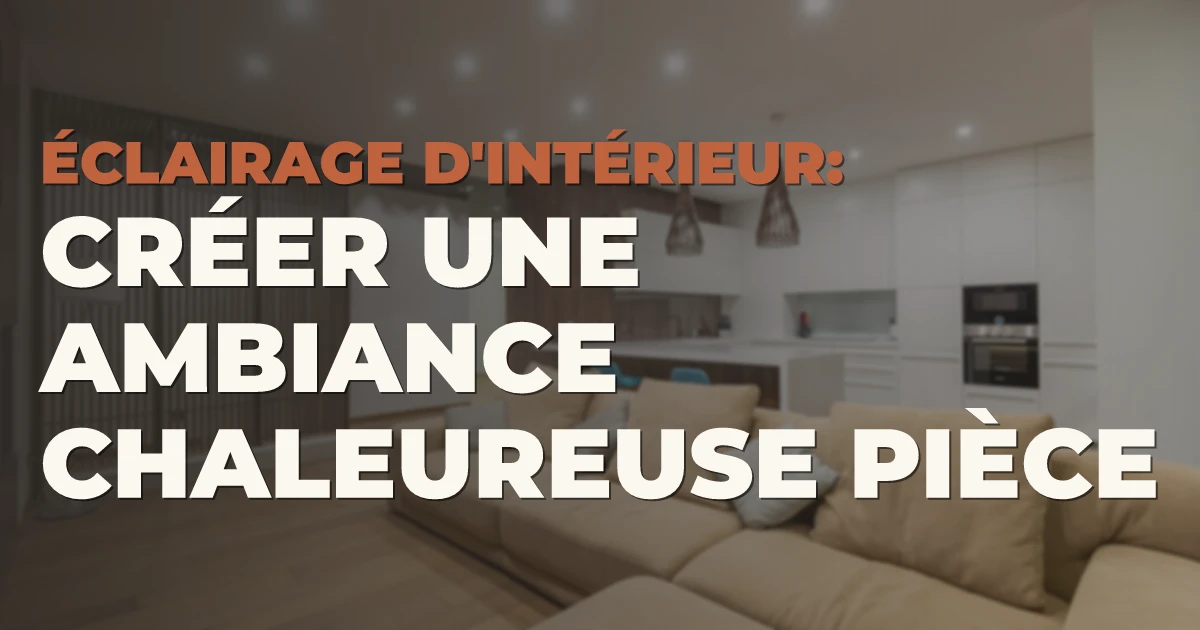
Indoor lighting: creating a warm ambiance room by room
Achieve the perfect indoor ambiance lighting room by room: color temperatures, lumens, dimmers, and decor tips for a warm interior.
A successful interior isn’t just about furniture or wall colors: light shapes the atmosphere, models volumes, and directly influences our well-being. Well-designed indoor ambiance lighting transforms a cold room into a welcoming cocoon and gives character to every space. In this comprehensive guide, we’ll guide you room by room to create a warm ambiance, combining technical benchmarks and practical decor tips. You’ll find color temperature references, luminous power, and easy-to-implement layout tips, whatever your budget.
Understanding color temperature: the foundation of successful ambiance lighting
Before choosing your light fixtures, you need to master an essential concept: color temperature, expressed in kelvins (K). It determines whether the light will be perceived as warm and enveloping or cold and stimulating. The lower the value, the more the light tends toward amber yellow; the higher it is, the closer it gets to a bluish-white similar to daylight. For a warm ambiance at home, a light between 2200 K and 3000 K, known as "warm white," is generally preferred.
This concept is complemented by the CRI (Color Rendering Index), which measures how faithfully a source reproduces the real colors of an object. A CRI above 90 is recommended in living spaces: it avoids the "dull" effect on fabrics, woods, and skin. Finally, luminous flux, measured in lumens, indicates the actual amount of light emitted, much more relevant than the old watts for comparing LED bulbs.
To learn more about choosing light sources, check out our dedicated guide on LED bulbs and energy savings, which details how to read an energy label without making mistakes.
Choosing the right color temperature for each room
Every space in the home has its function and therefore its own lighting needs. A kitchen requires clear light for safe cooking, while a bedroom calls for soft light that promotes sleep. The table below summarizes our recommendations for color temperature and luminous flux room by room to guide you in your purchases.
| Room | Recommended temperature | Indicative flux | Desired ambiance |
|---|---|---|---|
| Living room | 2400 - 2700 K | 1500 - 3000 lm distributed | Warm and convivial |
| Kitchen (worktop) | 3500 - 4000 K | 700 - 1000 lm per zone | Functional and precise |
| Bedroom | 2200 - 2700 K | 1000 - 2000 lm adjustable | Soothing and cozy |
| Bathroom | 3000 - 4000 K | 800 - 1200 lm | Bright but flattering |
| Office | 4000 K | 500 - 800 lm targeted | Focused and dynamic |
| Entryway / hallway | 2700 - 3000 K | 600 - 1000 lm | Welcoming |
These values are benchmarks: adjust them based on the size of the room, the color of the walls, and the available natural light. A room with dark walls absorbs light and requires more lumens than a space with light tones.
The living room: warm and adaptable ambiance lighting
The living room is where ambiance lighting truly shines. It’s a versatile space: for entertaining, reading, watching a movie, or relaxing. The golden rule is to multiply light sources rather than relying on a single central ceiling light, which is often too harsh and unflattering. This is called layered lighting.
Three complementary levels structure a successful living room:
- General lighting: a pendant or ceiling light diffusing soft, even light.
- Accent lighting: floor lamps, table lamps, and reading lights that create warm pools of light.
- Highlight lighting: LED strips, adjustable spotlights, or candles that showcase a bookshelf, painting, or plant.
To orchestrate these layers, a dimmer is your best ally: it allows you to transition from bright light during the day to a dimmed atmosphere in the evening. Also consider smart lighting, which adjusts temperature and intensity with a simple gesture. If you’re unsure about the main light fixture, our guide on choosing a living room pendant compares shapes, materials, and ideal heights.
The kitchen: combining functional lighting and convivial ambiance
The kitchen has become a living space in its own right, where we cook but also share meals. It must therefore reconcile two seemingly opposing requirements: precision for tasks and conviviality for shared moments. The solution once again lies in layering light sources.
Here are the priority areas to light:
- The worktop: LED strips under upper cabinets, around 3500-4000 K to clearly distinguish food.
- The island or table: one or more low-hanging pendants create a warm focal point.
- General lighting: recessed spots or a ceiling light for even base lighting.
The trick is to install a dimmer on the island pendant: bright light during preparation, dimmed ambiance during dinner. To optimize the work area, check out our tips on worktop lighting, where we detail the orientation and spacing of LED strips.
The bedroom: creating a cocoon for relaxation
In the bedroom, the goal is the opposite of the office: to promote relaxation and prepare the body for sleep. Sleep neuroscience confirms that too much blue light in the evening disrupts melatonin production. Therefore, warm light around 2200-2700 K is preferred, along with dimmed sources.
For a successful cocoon, multiply soft light sources: bedside lamps with fabric shades, adjustable wall sconces for reading, LED strips hidden behind the headboard for an indirect glow. Avoid a single, overly powerful ceiling light, which instantly breaks the cozy atmosphere. Our feature on cozy bedroom ambiance offers material and lighting combinations to take it further.
A few simple steps enhance visual comfort:
- Choose dimmable bulbs to reduce intensity in the evening.
- Direct light sources toward walls or the ceiling for indirect, enveloping lighting.
- Opt for linen or cotton lampshades, which soften diffusion.
Bathroom, entryway, and office: adapting indoor lighting to each use
So-called "technical" rooms deserve just as much attention. In the bathroom, lighting should be flattering without being harsh: combine general lighting at 3000-4000 K with frontal lighting on either side of the mirror to avoid unflattering shadows on the face. Ensure you respect the appropriate IP (Ingress Protection) ratings for humidity, essential for safety.
The entryway, the first impression of your interior, should be welcoming: warm light around 2700 K, a sconce or pendant that sets the decorative tone from the threshold. The office, finally, requires more dynamic light, around 4000 K, and especially an adjustable task lamp to prevent eye strain. Position the light source opposite your writing hand to limit shadows.
And if you want to extend the ambiance beyond the walls, our guide on garden and terrace lighting applies these same principles of layering and warm light to your outdoor spaces.
Energy savings: warm lighting doesn’t mean waste
Creating a warm ambiance doesn’t mean increasing your bill. The latest generation of LEDs offers a warm glow while consuming up to 80% less energy than old incandescent bulbs. The smart approach is to think in lumens rather than watts and to prioritize high-CRI sources to enjoy beautiful light without overconsuming.
According to ADEME, lighting accounts for nearly 10% of a household’s electricity bill on average, and switching to LED bulbs significantly reduces this consumption while maintaining high visual comfort.
To learn more about best practices and objectively compare bulb models, you can consult the official resources of the ADEME, which regularly publishes independent benchmarks on household equipment consumption.
Mistakes to avoid for harmonious ambiance lighting
Even with beautiful light fixtures, a few missteps can ruin the atmosphere. The most common ones are easy to correct once identified:
- Relying on a single central ceiling light, which flattens volumes and hardens faces.
- Mixing inconsistent color temperatures in the same room, creating a sense of disorder.
- Underestimating luminous flux in large rooms or those with dark walls.
- Forgetting dimmers, which provide valuable flexibility.
- Neglecting indirect lighting, which is key to a truly enveloping ambiance.
By correcting these points and thinking in layers, you’ll create an interior that is both functional and deeply welcoming, where light enhances every space throughout the day.
A question?
Get in touch directly.
Discussion
Our advice related to Buying-guides
 buying-guides
Mesurer sa fenêtre avant d'acheter un store : largeur du tissu ou largeur totale
Largeur du tissu ou largeur totale : où poser le mètre selon la pose (embrasure, applique) et comment lire un intitulé produit sans se tromper.
 buying-guides
Le store en bambou : tamiser la lumière avec une matière naturelle
Découvrez comment le store en bambou filtre la lumière, son entretien face à l'humidité et les pièces où il révèle tout son potentiel naturel.
 buying-guides
Store enrouleur occultant, tamisant ou jour-nuit : lequel pour quelle pièce
Chambre, bureau ou séjour : quelle toile de store enrouleur choisir selon l'usage réel de chaque pièce. Guide clair, sans promesse chiffrée, par Sunaya Home.